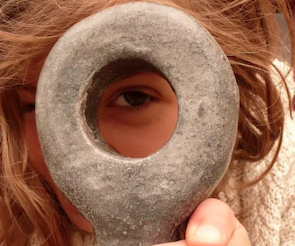

This collaboration is the first in a series of mixed media animations that my sister and I are creating together. Centred around our family ancestry and heritage, we want to research and represent each individual element that makes up our lineage. For this first piece we decided to explore the roots of our Norse heritage.
Scandinavia, specifically Norway, is relevant to our family on both our mother and father’s side and so we felt it most natural to begin this project series with such a prominent aspect of our history, one that previously, neither me nor my sister knew much about.
ERLUND
Erlund, the maiden name of our grandmother on our father’s side, has its historical roots in Scandinavia, particularly Norway, where it is believed to have originated as a patronymic surname. The name derives from Old Norse – a north Germanic language spoken by the inhabitants of Scandinavia and their overseas settlements during the Viking Age and early Middle Ages (roughly 800–1350 AD).
The ER from Erlund comes from the Old Norse word erlendr, which translates to ‘foreigner’ or ‘from a foreign land.’ In the Viking Age, this was a very common name for someone who had traveled across the seas, if a man left Norway to settle in a new place, he was often nicknamed Erlendr.
The LUND derives from the Old Norse word lundr, meaning a grove, or small wood, often associated with sacred, worshipped, or holy places. These were locations where rituals were performed and spirits were said to dwell. The name may have originally been associated with individuals who lived near a grove or forest, or perhaps those who were seen as outsiders in a community.
- Erl: foreigner or stranger
- Lund: grove or wood.
Erlund literally translates to “The Grove of the Man from a Far Land.”
Over time, the surname Erlund evolved, with its bearers often taking on roles related to agriculture, forestry, or trade, reflecting the natural resources of the regions they inhabited.
Cumbrian Norse
Our other relation to Nordic roots links to the norse settlers of North West England, specially Cumbria.
The specific group of Norsemen associated with Cumbria are known as the ‘Hiberno-Norse’. Unlike the Danes who settled in Eastern England, the Cumbrian settlers were Norwegian, and weren’t usually direct raiders from Scandinavia. Instead, they were Norwegians who had lived in Ireland, the Isle of Man, and the Hebrides for generations before moving into Cumbria around 900–950 AD.
DNA studies in towns across the Lake District show some of the highest concentrations of Norwegian genetic markers in the UK.
Timney, our mother’s last name is originally an Irish name, the anglicized form of the Gaelic name Ó Tiománaigh, meaning ‘driver’, the cattle driver or the horse driver. The name was heavily associated to Southern County Donegal and the neighbouring parts of County Tyrone and County Fermanagh (in the province of Ulster).
The name comes from the people in Ireland who fought off the very Norse invaders who took over and found a permanent home in Cumbria, the ‘Erlendrs‘.
Although originally deriving from Ireland, the Timney family has been settled in West Cumbria for the last two centuries having immigrated from Ireland in the early 1800s. Having been firmly based in Cumbria since, our Timney family is very aware of the history and heritage of the area, therefore the norse impact.
Aspects of the Cumbrian dialect are actually phrases and words left over from norse invasions, resulting in many words showing closer links to Danish and Norwegian than to standard English. The dialect has distinct vocabulary for landscapes, farming, and daily life, such as beck (stream), fell (mountain), laik (play), and lowp (jump) – all of which are from the Norse influence.
My sister and I know our Timney side to be Cumbrian, proudly, and so we feel this connection to the Norse impact of the area, making it feel most uniting of the two separate sides of our lineage.
For the narrative aspect of this project we wanted to creative a visual work that held a depth of personal meaning to us both, which through the themes of ancestry we have been able to achieve. However we decided thus to focus on one element of our research in order to make the final outcome interpretable, meaningful for both us and the viewer, as well as being visually beautiful and interesting. We realised it would be easy to quickly get lost in the vast depths of our lineage, ending up with a less defined piece. And so for this work we decided to centre it around folklore stories from Nordic culture, specially Norwegian folklore.
HULDRA
A Huldra, or Huldre (plural), is a female forest spirit who appears human at first, known for her immense beauty, long hair, and irresistibly alluring presence, however as you look closer you’ll see hidden, her cow’s tail (or fox’s tail) and hollowed out, tree-like back. All carefully disguised under long clothing.
An incredibly protective creature, the Huldra can be benevolent, offering protection or good luck, but often becomes malevolent if scorned, cursing men or causing them to vanish. Huldra could charm anyone who crossed her path, particularly men, her beauty was magical, capable of clouding the minds of the people who engaged with her. Huldra’s powers were strongest in the forest, she could guide people to safety or lead them astray, whichever she pleased, in some tales, she helped hunters find game or cursed them if they disrespected the woods. However, she wasn’t malicious by default, her doings regarded the morals of the being.
She is both compassionate and merciless.
This duality of behaviours reflects the way ancient Norse cultures viewed the natural world, life and death, the ever giving and the complete soul destroying aspects of our life. A rather beautiful interpretation of existence in a being, encouraging us to look beyond initial appearances, to consider and comprehend the consequences of our actions, and to approach the world around us with a certain care.
In contemporary times, forests cover vast areas of the Nordic countries; roughly 75% of Finland, 70% of Sweden, more than 30 % of Norway, and 15 % of Denmark. Therefore it makes sense that the narratives of Nordic folklore often revolve around the forest and the spirits they contain. Confrontations with supernatural forest spirits are old and belong to a popular tradition of pre-Christian origin in Scandinavia, going back at least to the Viking Age.
In Scandinavian tradition, the Huldra is a Skogsrå, a forest spirit, she resides in the ‘lunds’, the patches of ancient trees where the light filters through the leaves in strange ways. The same ‘lund’ from the name Erlund.
As mentioned, these groves were often considered sacred or taboo, and were the places where the land between our world and the Huldrefolk (the hidden people) wore thinnest.
In Norway, the word Huldra, Hulder & Huldrefolk derived from the Old Norse ‘huldr’ meaning hidden, used for all kinds of supernatural beings, sighted and talked about by the locals. Folklore suggests that there is an entire Hulder race, who are one of several ‘rå’ (keepers/ wardens).
A Huldra’s appearance and environment were rich with symbolic meaning. Reflecting her deep connection to nature and the idea that beauty conceals hidden aspects.
- Cow’s Tail: The most iconic, distinguishable feature of a Huldra, separating her from human, the tail connects her to the animal kingdom, showing that she’s a creature of the wild, not bound by human rules or culture.
- Hollow Back: Huldra’s hollow back is a powerful symbol of deception and the unknown, suggesting that initial perceptions of appearing perfect may hide a dark or empty truth.
- Forests and Trees: Associated with deep, dark woodland, birch and pine trees are often linked to her presence. She is hidden away from the rest of society, safe in the unfamiliar territory of the forest.
- Sounds of Nature: The voice of a Huldra is said to be heard through songs or distant laughter, symbolising both enchantment and warning, an invitation to follow, or a trap to be avoided. Whispers in the wind or a sudden stillness in the forest may signal that she’s close.
The Huldra is the ultimate outsider she is someone from a far land or another realm entirely. The understanding and perception of the Huldra relates closely to the defining elements of my family name Erlund. There is a recurring theme in Scandinavian tales of a foreigner (an Erlund) wandering into a strange grove and being taken by the Huldra. He then becomes an elf-shot or bergtatt (taken into the mountains). -This can also link to being taken to the fells (the mountains) of Cumbria, creating this connection to the other side of our family.
When the Norse settled in Cumbria, they moved from the fjords of Norway to the fells of the Lake District. In folklore, it was believed that when a family migrated, their ‘land-spirits’ (Landvættir) followed them along the journey.
Unlike mythological Norse figures like Odin or Freya, Huldra doesn’t appear in the Poetic or Prose Edda- the two primary, 13th-century sources for Norse mythology. Instead, she lives in the realm of folktale, where everyday people encounter magical, spirit-like beings. Her role is closer to that of a forest guardian, protecting her domain while interacting with humans in ways that are both enchanting and fearsome.
When deciding which folklore story best depicts our relation to norse roots, I was particularly attracted to the Huldra for a number of reasons. I liked the polarity of her existence, the meaning given to her presence in the woods. I also felt this strong relation to Erlund being a ‘foreigner in a grove’, which is essentially what the Huldra is, on a basic level. We come from the same environment.